2 Introduction
2.1 Origins of Algebra
- Mesopotamia and Egypt (c. 2000–1600 BCE)
- Early problem-solving (linear/quadratic equations) in word problems
- No formal symbols, but systematic procedures
- Greek Era (c. 600 BCE–300 CE)
- Geometric methods for solving equations (Euclid, Apollonius)
- Diophantus introduced proto-symbolic notation
- Islamic Golden Age (8th–12th Century)
- Al-Khwarizmi’s work Al-jabr \rightarrow term “Algebra”
- Systematic solutions for linear and quadratic equations
- Transmission to Europe (12th–17th Century)
- Latin translations influenced Fibonacci, others
- Viète, Descartes established modern symbolic notation and analytic geometry
- Modern Algebra (19th–20th Century)
- Emergence of abstract algebra (groups, rings, fields)
- Galois, Abel, and others formalized algebraic structures
2.2 What is Algebra?
Algebra is a branch of mathematics that deals with numbers, variables, and their relationships. Key concepts include:
- Variables — symbols (like x, y) representing unknown or changing values.
- Expressions — combinations of variables, numbers, and operations. E.g., 2x + 3.
- Equations — mathematical statements that express equality, e.g., 2x + 3 = 7.
- Solving equations — finding values for variables that make an equation true.
- Polynomials — expressions like 3x^2 + 2x - 5 involving variables raised to powers.
- Functions — describes a relationship between variables, e.g., y = 2x + 1.
2.3 Why Algebra is Important in Machine Learning
- Data representation. Data is often represented as vectors, matrices, and tensors. Algebra provides the tools for efficiently handling these structures.
- Model building. Many machine learning models (e.g., linear regression, neural networks) rely on algebraic operations like matrix multiplication and linear transformations.
- Optimization. Training models involves solving systems of equations, computing gradients, and performing matrix decompositions, all of which require algebra.
- Theoretical insights. Concepts such as feature spaces, eigenvalues, eigenvectors, and dimensionality reduction (e.g., PCA) are based on algebraic principles.
- Computational efficiency. Algebraic methods enable the development of efficient algorithms that can be optimized for modern hardware.
2.4 Integers
The set of integers is denoted by \mathbb{Z}, and includes:
\ldots, -3, -2, -1, 0, 1, 2, 3, \ldots
Formally, \mathbb{Z} = \{\dots, -2, -1, 0, 1, 2, \dots\}.
Common properties.
- \mathbb{Z} is infinite and unbounded in both the negative and positive directions.
- Closed under addition, subtraction, and multiplication:
\forall a, b \in \mathbb{Z}, \quad a \pm b \in \mathbb{Z}, \quad a \cdot b \in \mathbb{Z}.
The quotient of two integers is not necessarily an integer, so we extend arithmetic to rational numbers.
2.5 Rational Numbers
The set of rational numbers is denoted by \mathbb{Q}, defined as:
\mathbb{Q} = \left\{ \frac{p}{q} \,\middle|\, p \in \mathbb{Z}, \; q \in \mathbb{Z}, \; q \neq 0 \right\}.
Every integer is also a rational number (e.g., 5 = \tfrac{5}{1}).
Examples.
\frac{1}{2}, \quad -\frac{3}{4}, \quad 0, \quad 7, \quad \frac{11}{5}, \ldots
Properties.
- Closed under addition, subtraction, multiplication, and division (except division by zero).
- Densely packed on the number line — between any two rationals, there is another rational.
2.6 Interesting Facts
Division is the inverse of multiplication in the sense
\frac{m}{n} \cdot n = m.
If n = 0 and m = 1, we get \frac{1}{0} \cdot 0 = 1, which is nonsensical because any number multiplied by zero is zero.
- Rational numbers suffice for all actual physical measurements like weight, height, and length.
- But geometry, algebra, and calculus force us to consider real numbers.
2.7 A Real Number Line

If n is a positive integer, then \tfrac{1}{n} is to the right of 0 by the length obtained by dividing the segment from 0 to 1 into n segments of equal length.
2.8 Is Every Real Number a Rational?
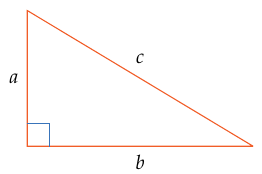
By the Pythagorean theorem, c^{2} = a^{2} + b^{2}. If a = 1 and b = 1, then c^{2} = 2. So which rational number is c?
By trial and error,
\left( \frac{99}{70} \right)^{2} = \frac{9801}{4900}
where the numerator just misses twice the denominator by 1 — close to 2, but not 2. Another attempt:
\left( \frac{9369319}{6625109} \right)^{2} = 1.999999999999977,
still not 2. The Greeks proved that it is impossible to find any rational number whose square is 2.
2.9 Proof: No Rational Number Has a Square Equal to 2
Suppose m and n are integers and
\left( \frac{m}{n} \right)^{2} = 2,
with \tfrac{m}{n} already reduced to lowest terms (no common factors). Then:
m^{2} = 2n^{2},
so m^{2} is even, and therefore m is even (the square of an even integer is even; the square of an odd integer is odd). Write m = 2k for some integer k. Substituting:
4k^{2} = 2n^{2} \;\Longrightarrow\; 2k^{2} = n^{2},
so n^{2} is even, and therefore n is even. But then m and n share a common factor of 2, which contradicts our assumption that \tfrac{m}{n} was in lowest terms. \blacksquare
2.10 Irrational Numbers
A real number that is not rational is an irrational number.
Examples:
- \sqrt{2}
- 3 + \sqrt{2}
- 8\sqrt{2}