9.1 An applied scenario — smoothing the vibration stream
Back to the running motor. The raw accelerometer stream is jagged — every sample is a noisy snapshot. To get a stable reading you do the obvious thing: take a moving average over the last n samples.
Try n = 10. The output is calmer than the raw stream but still bumpy. Try n = 100. Calmer still. Try n = 1000 and the smoothed signal is almost glassy.
Two things happen as n grows:
The spread of the smoothed signal shrinks. Doubling n shrinks the spread by \sqrt{2}.
The shape of the smoothed signal’s distribution converges to a clean bell curve — even if the raw samples have a weird, skewed, or bimodal distribution.
The first observation is intuitive. The second is much deeper, and it’s the most useful theorem in all of probability.
9.2 The theorem
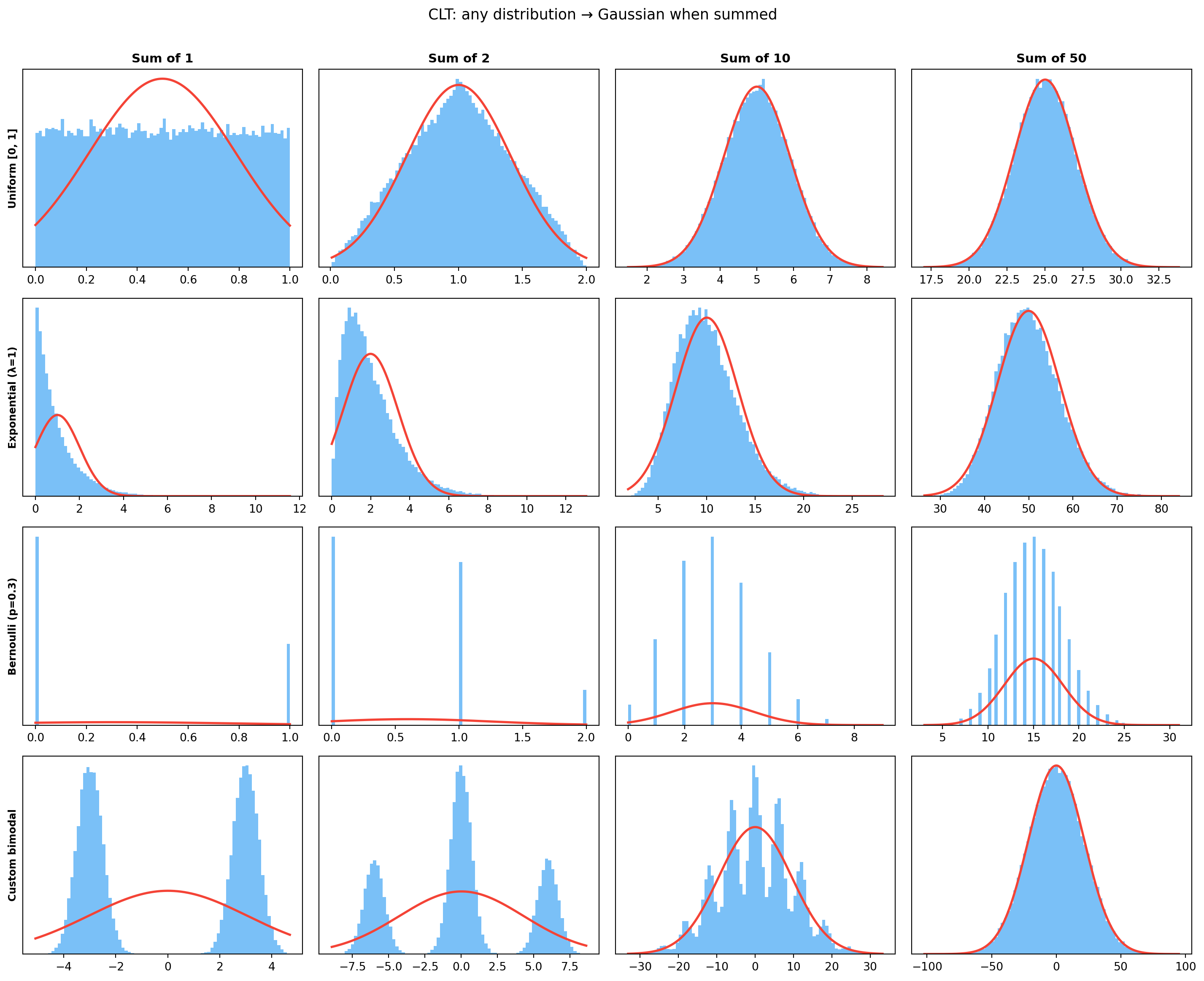
The Central Limit Theorem (CLT) says: if you sum or average many independent random variables, the result is approximately Normal — regardless of what distribution the individual variables came from.
Let X_1, X_2, \ldots, X_n be independent with mean \mu and variance \sigma^2. Then as n \to \infty, the sample mean\bar{X} = \frac{1}{n}\sum X_i converges to:
Or equivalently, the sum S_n = \sum X_i converges to:
S_n \;\sim\; \mathcal{N}(n\mu, \, n\sigma^2)
The individual X_i can be from any distribution — uniform, exponential, Poisson, Bernoulli, even something bizarre and bimodal. As long as you sum enough of them, the result is Gaussian.
9.3 Back to the smoothed vibration
For the moving-average filter on the accelerometer stream:
\sigma^2 — variance of one raw sample
n — window length
Smoothed sample variance: \sigma^2 / n
Smoothed sample standard deviation: \sigma / \sqrt n
That’s the 1/\sqrt n noise reduction law, and it falls out of the CLT for free. Want half the noise? Quadruple the window. Want a tenth of the noise? Multiply the window by 100.
It’s also why a smoothed signal looks Gaussian-distributed even when the raw stream is wildly non-Gaussian (impulsive transients, clipped values, mixed regimes). Averaging always pulls you toward the bell.
9.4 CLT in action — sums of non-Gaussian variables
Each row starts non-Gaussian. By column 4 (sum of 50), every distribution looks like a clean bell — the CLT, regardless of where you started.
9.5 CLT explains Poisson → Normal
The Poisson(\lambda) random variable can be thought of as the sum of \lambda independent Poisson(1) variables. By the CLT, this sum converges to \mathcal{N}(\lambda, \lambda) as \lambda \to \infty. The Poisson-to-Normal convergence from the previous chapter is just one instance of the same theorem.
9.6 A sensor reading is already a sum
A single reading from almost any sensor is itself a sum of many independent contributions:
By the CLT the total error is approximately Gaussian even though the individual sources have completely different distributions. This is the deeper reason every classical signal-processing tool — Wiener, Kalman, Gaussian denoising, least-squares — assumes Gaussian noise.
9.7 Convergence rate
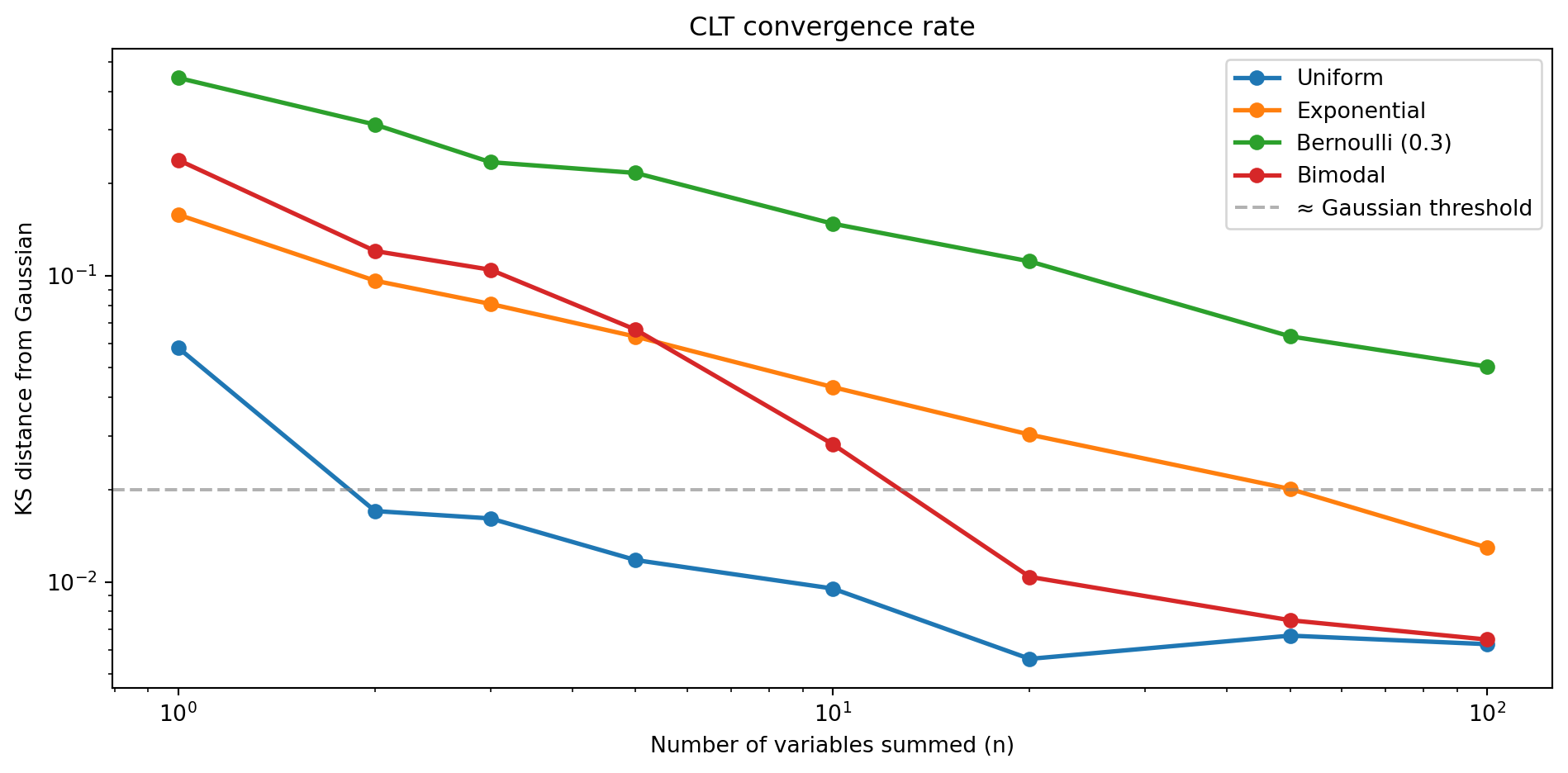
Convergence to Normal is fast for some distributions and slow for others. The rate depends on the skewness of the original distribution.
The convergence rate is approximately O(1/\sqrt n). In practical terms, this tells you how long a moving-average window needs to be before the smoothed output is genuinely Gaussian, or how many frames to average before a Gaussian-based background-subtraction model is valid.
9.8 Exercises
For X \sim \text{Uniform}[0, 1], simulate the sample mean of n = 5, 30, 100 samples 10 000 times each. Plot the three sampling distributions on the same axes.
Verify the 1/\sqrt n rule: plot the std of the sample mean vs n on a log-log scale; the slope should be -1/2.
Run a KS test on standardised sums of an exponential distribution. At what n does the KS statistic drop below 0.02?
Sums of Cauchy random variables do not become Gaussian. Why? (Hint: think about the assumption “finite variance”.)
9.9 Glossary
CLT — sample mean of many i.i.d. variables is approximately Normal.
i.i.d. — independent and identically distributed.
1/\sqrt n rule — std of sample mean shrinks as \sigma /
\sqrt n.
KS distance — Kolmogorov–Smirnov statistic; max gap between empirical and theoretical CDF.
convergence rate — how fast the limit is approached as n grows.