22  Estimation

22.1 The question

“We measured 9,148 babies. But we want to say something about ALL babies. How good is our estimate?”

Everything computed so far is a sample statistic — a number computed from the data we have. What we really want is a population parameter — the true value in the real world.

The sample mean \bar{x} is our best guess for the population mean \mu. But how far off is it likely to be?


22.2 The estimation game

Suppose a population is normal with unknown \mu and \sigma. You draw a random sample of n observations. Your best estimate of \mu? The sample mean \bar{x} — the maximum likelihood estimator of \mu for a normal distribution.

Variance is subtler. The naive estimate

\hat{\sigma}^2 \;=\; \frac{1}{n}\sum_{i=1}^n (x_i - \bar{x})^2

is biased — it systematically underestimates \sigma^2. The unbiased estimator divides by n - 1 instead:

s^2 \;=\; \frac{1}{n-1}\sum_{i=1}^n (x_i - \bar{x})^2

We estimated \bar{x} from the data. That used up one degree of freedom — the deviations (x_i - \bar{x}) sum to zero, so the last one is not free. Dividing by n-1 corrects for this.

For large n, the difference is negligible. For small n (say n = 5), it matters.


22.3 Sampling distributions

If you draw many samples and compute the mean of each, the distribution of those means is the sampling distribution of the mean.

For a population with mean \mu and std \sigma:

E[\bar{X}] = \mu, \qquad \operatorname{Std}(\bar{X}) \;=\; \frac{\sigma}{\sqrt{n}}

The standard error shrinks as \sqrt{n} — doubling sample size cuts error by \sqrt{2}.


22.4 Standard error in NSFG

import sys, os
import numpy as np
import matplotlib.pyplot as plt

sys.path.insert(0, os.path.dirname(os.path.abspath("__file__")) or ".")
from _nsfg import load_groups, COLORS

live, _, _ = load_groups()
weights = live["totalwgt_lb"].dropna().values
weights = weights[(weights > 0) & (weights < 20)]

true_mean = weights.mean()
true_std  = weights.std()

print(f"σ ≈ {true_std:.3f} lbs, n = {len(weights):,}")
print(f"SE = σ/√n = {true_std / np.sqrt(len(weights)):.4f} lbs")
σ ≈ 1.463 lbs, n = 9,084
SE = σ/√n = 0.0153 lbs

Our estimate of the mean is likely within ≈ 0.015 lbs of the true mean.


22.5 Biased vs unbiased variance — a simulation

np.random.seed(42)
sample_size = 10
n_simulations = 10_000

biased, unbiased = [], []
for _ in range(n_simulations):
    s = np.random.choice(weights, size=sample_size, replace=False)
    m = s.mean()
    biased.append(np.sum((s - m) ** 2) / sample_size)
    unbiased.append(np.sum((s - m) ** 2) / (sample_size - 1))

true_var = weights.var()

print(f"True variance              : {true_var:.4f}")
print(f"Mean of 1/n estimates      : {np.mean(biased):.4f}")
print(f"Mean of 1/(n-1) estimates  : {np.mean(unbiased):.4f}")
print(f"Bias 1/n                   : {np.mean(biased) - true_var:+.4f}")
print(f"Bias 1/(n-1)               : {np.mean(unbiased) - true_var:+.4f}")
True variance              : 2.1391
Mean of 1/n estimates      : 1.9136
Mean of 1/(n-1) estimates  : 2.1262
Bias 1/n                   : -0.2255
Bias 1/(n-1)               : -0.0129

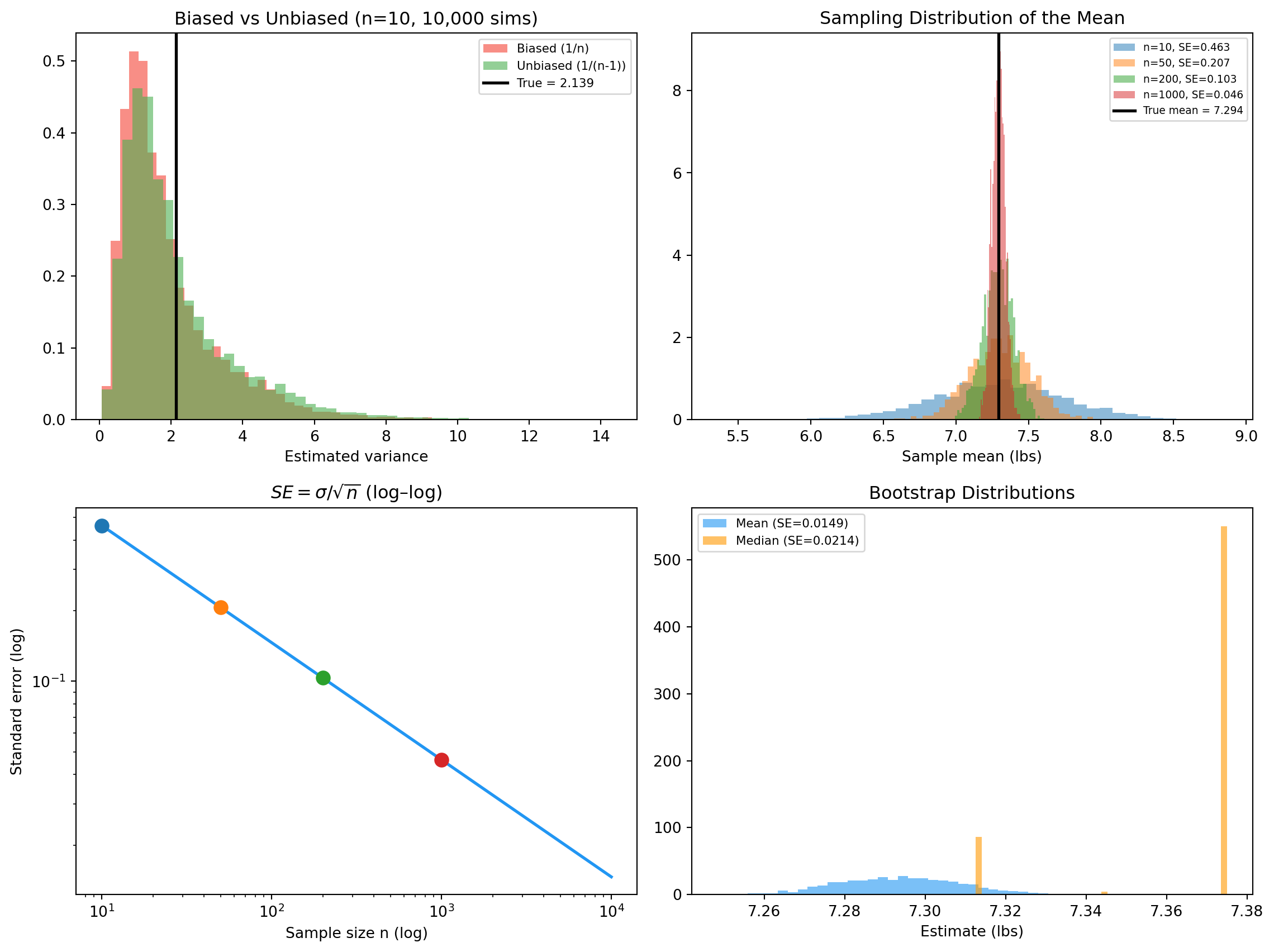
The 1/n estimator is biased downward by exactly the predicted amount; the 1/(n-1) estimator is right on the nose.


22.6 SE shrinks as σ/√n

sample_sizes = [10, 50, 200, 1000]
sampling = {}
print(f"  {'n':>6}  {'SE (analytic)':>15}  {'SE (simulated)':>15}")
for n in sample_sizes:
    means = [np.random.choice(weights, size=n).mean() for _ in range(2000)]
    se_a = true_std / np.sqrt(n)
    se_s = np.std(means)
    sampling[n] = (means, se_a, se_s)
    print(f"  {n:>6}  {se_a:>15.4f}  {se_s:>15.4f}")
       n    SE (analytic)   SE (simulated)
      10           0.4625           0.4562
      50           0.2068           0.2095
     200           0.1034           0.1038
    1000           0.0463           0.0451

SE halves when n quadruples.


22.7 Sampling bias

Not all estimation errors are random. Bias is a systematic error that doesn’t average away with more data.

The class size paradox is a clean example: sampling students oversamples large classes, so the estimate of mean class size is biased upward — taking more data makes it more precise but not more accurate.

NSFG uses survey weights (finalwgt) to correct for deliberate oversampling of minority groups. If you ignore the weights, your estimates of national statistics will be biased.
df = live[["totalwgt_lb", "finalwgt"]].dropna()
df = df[(df["totalwgt_lb"] > 0) & (df["totalwgt_lb"] < 20)]

unweighted = df["totalwgt_lb"].mean()
weighted   = np.average(df["totalwgt_lb"], weights=df["finalwgt"])

print(f"Unweighted mean : {unweighted:.4f} lbs")
print(f"Weighted mean   : {weighted:.4f} lbs")
print(f"Difference      : {weighted - unweighted:+.4f} lbs")
Unweighted mean : 7.2936 lbs
Weighted mean   : 7.3819 lbs
Difference      : +0.0883 lbs

Difference is small for birth weight specifically, but the principle matters: ignoring survey weights gives biased national estimates.


22.8 Bootstrap — simulation-based standard errors

We often can’t compute SE analytically (think: median, correlation, ratio). The bootstrap is a simulation alternative:

  1. Draw B bootstrap samples — resample with replacement from your data
  2. Compute the statistic for each sample
  3. The standard deviation of the B estimates is the bootstrap SE
def bootstrap_se(data, statistic, n_boot=2000):
    estimates = [statistic(np.random.choice(data, size=len(data), replace=True))
                 for _ in range(n_boot)]
    return np.std(estimates), estimates


se_mean,   boot_means   = bootstrap_se(weights, np.mean)
se_median, boot_medians = bootstrap_se(weights, np.median)

print(f"Mean   : {weights.mean():.4f}  ±  {se_mean:.4f} (SE)")
print(f"Median : {np.median(weights):.4f}  ±  {se_median:.4f} (SE)")
print(f"Analytic SE for mean: {true_std / np.sqrt(len(weights)):.4f}")
Mean   : 7.2936  ±  0.0149 (SE)
Median : 7.3750  ±  0.0214 (SE)
Analytic SE for mean: 0.0153

Bootstrap and analytic SE agree closely for the mean. The bootstrap just works for any statistic — that’s its real value.


22.9 Visualising it

fig, axes = plt.subplots(2, 2, figsize=(12, 9))

# 1. biased vs unbiased
ax = axes[0, 0]
ax.hist(biased,   bins=50, density=True, alpha=0.6,
        color=COLORS["highlight"], label="Biased (1/n)")
ax.hist(unbiased, bins=50, density=True, alpha=0.6,
        color=COLORS["other"],     label="Unbiased (1/(n-1))")
ax.axvline(true_var, color="black", linewidth=2,
           label=f"True = {true_var:.3f}")
ax.set_xlabel("Estimated variance")
ax.set_title(f"Biased vs Unbiased (n={sample_size}, {n_simulations:,} sims)")
ax.legend(fontsize=8)

# 2. Sampling distributions
ax = axes[0, 1]
for n in sample_sizes:
    means, se_a, _ = sampling[n]
    ax.hist(means, bins=40, density=True, alpha=0.5, label=f"n={n}, SE={se_a:.3f}")
ax.axvline(true_mean, color="black", linewidth=2,
           label=f"True mean = {true_mean:.3f}")
ax.set_xlabel("Sample mean (lbs)")
ax.set_title("Sampling Distribution of the Mean")
ax.legend(fontsize=7)

# 3. SE = σ/√n on log-log
ax = axes[1, 0]
n_range = np.logspace(1, 4, 50)
ax.loglog(n_range, true_std / np.sqrt(n_range),
          color=COLORS["first"], linewidth=2)
for n in sample_sizes:
    _, se_a, _ = sampling[n]
    ax.scatter([n], [se_a], s=80, zorder=5)
ax.set_xlabel("Sample size n (log)")
ax.set_ylabel("Standard error (log)")
ax.set_title(r"$SE = \sigma / \sqrt{n}$ (log–log)")

# 4. Bootstrap mean vs median
ax = axes[1, 1]
ax.hist(boot_means,   bins=40, density=True, alpha=0.6,
        color=COLORS["first"], label=f"Mean (SE={se_mean:.4f})")
ax.hist(boot_medians, bins=40, density=True, alpha=0.6,
        color="#FF9800",       label=f"Median (SE={se_median:.4f})")
ax.set_xlabel("Estimate (lbs)")
ax.set_title("Bootstrap Distributions")
ax.legend(fontsize=8)

plt.tight_layout()
plt.show()

Biased vs unbiased variance, sampling distributions, the σ/√n curve, and bootstrap distributions of mean and median.

22.10 Exercises

  1. Simulate drawing 100 samples of size n = 50 from birth weight. Plot the sampling distribution of the mean.
  2. Compute the SE analytically and compare to the simulated std of sample means.
  3. Bootstrap the median birth weight. What is the bootstrap SE?
  4. Compute the mean with and without survey weights (finalwgt). How different are they?
  5. Show that the 1/n variance estimator is biased: simulate many samples, compute 1/n variance each time, average. Does it equal the true variance?

22.11 Glossary

sample statistic — value computed from data (e.g., \bar{x}).

population parameter — true value in the population (e.g., \mu).

estimator — formula for computing a parameter from sample data.

bias — systematic error; E[\hat{\theta}] - \theta.

unbiased estimatorE[\hat{\theta}] = \theta.

sampling distribution — distribution of a statistic over many repeated samples.

standard error — std of the sampling distribution; SE = \sigma/\sqrt{n} for the mean.

bootstrap — resample with replacement to simulate the sampling distribution.

degrees of freedom — number of values free to vary; affects bias in variance estimation.